Introduction
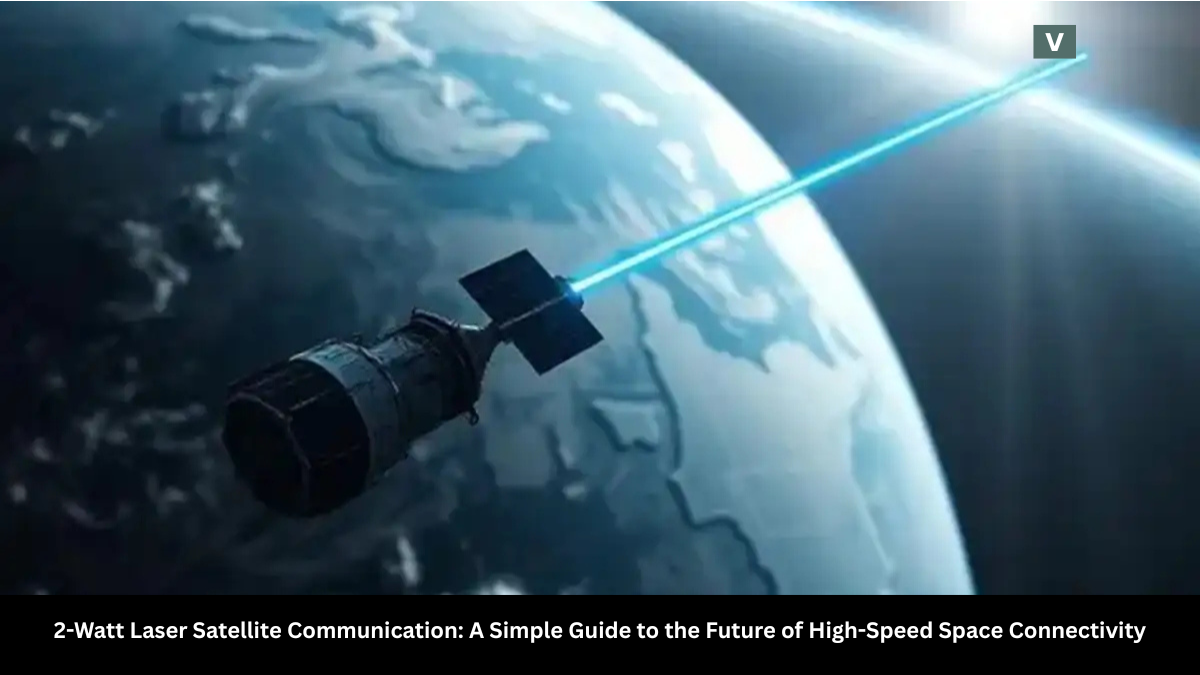
The world of satellite technology is evolving rapidly, and one innovation attracting significant attention is 2-watt laser satellite communication. Unlike traditional radio frequency (RF) systems, laser communication uses beams of light to transfer data between satellites or between satellites and ground stations. Even with a relatively low power output of just two watts, modern optical communication systems can deliver impressive data transmission speeds while consuming less energy.
As governments, private space companies, and research institutions continue launching more satellites into orbit, the need for faster, more reliable communication becomes increasingly important. A 2-watt laser transmitter demonstrates how advances in optics and engineering allow powerful performance without requiring large amounts of electrical power.
This article explains how 2-watt laser satellite communication works, why it matters, where it is used, and what the future holds for this exciting technology.
What Is 2-Watt Laser Satellite Communication?
At its core, 2-watt laser satellite communication refers to a satellite communication system that transmits information using a laser with an optical output power of approximately two watts. Instead of broadcasting radio waves in many directions, the laser creates a highly focused beam of light that travels directly to its destination.
Because the beam is extremely narrow, very little energy is wasted during transmission. This focused approach allows satellites to exchange enormous amounts of information while using surprisingly low power compared to many traditional communication systems.
Laser communication is often called optical communication because it relies on infrared or near-infrared light. The receiver uses specialized optical sensors to detect these light signals and convert them back into digital information.
How Does 2-Watt Laser Satellite Communication Work?
The communication process begins when digital information is converted into light pulses. A precision laser transmitter rapidly switches the laser on and off or changes its properties to encode data into the beam.
Next, advanced pointing and tracking systems ensure the laser remains perfectly aligned with another satellite or a ground-based optical terminal. Since the beam is extremely narrow, even tiny alignment errors could interrupt communication, making precision one of the most critical parts of the system.
Once the beam reaches its destination, sensitive optical detectors capture the light and decode the transmitted information. Powerful error-correction algorithms further improve reliability, ensuring accurate communication even across thousands of kilometers in space.
Why a 2-Watt Laser Is More Powerful Than It Sounds
Many people assume that two watts is too little power for satellite communication. However, optical communication works very differently from traditional radio systems. Because laser beams remain tightly focused over long distances, much more of the transmitted energy reaches the receiver.
Traditional RF antennas spread signals over wide areas, meaning much of the energy never reaches the intended target. Laser systems minimize this energy loss through extremely narrow beam divergence.
Modern optical amplifiers, sensitive detectors, and advanced modulation techniques further enhance performance. Together, these technologies enable a modest 2-watt laser to support remarkably high-speed communication links in space.
Advantages of 2-Watt Laser Satellite Communication
One of the biggest advantages is significantly higher bandwidth. Laser communication can transfer much larger amounts of data than many conventional RF systems, making it ideal for high-resolution Earth observation, scientific missions, and broadband internet services.
Another important benefit is enhanced security. Since laser beams are highly directional, intercepting the communication is much more difficult than intercepting radio signals that spread over large areas. This makes optical communication attractive for defense and government applications.
Energy efficiency is another major strength. Satellites have limited electrical power, making every watt valuable. A 2-watt laser communication system delivers excellent performance while helping spacecraft conserve precious energy.
Applications of 2-Watt Laser Satellite Communication
One common application involves satellite-to-satellite communication. Large constellations in low Earth orbit use laser links to transfer information directly between satellites without relying solely on ground stations.
Earth observation satellites also benefit greatly. High-resolution imaging satellites generate enormous amounts of data that must be transmitted efficiently. Laser communication enables much faster downloads of these large datasets.
Deep-space exploration missions are another promising application. As missions travel farther from Earth, higher-capacity communication becomes increasingly important. Laser technology offers the potential to transmit scientific data more efficiently across vast interplanetary distances.
Challenges Facing Laser Satellite Communication
Despite its many advantages, laser communication is not without challenges. One of the biggest difficulties is maintaining extremely precise alignment between moving satellites. Even tiny pointing errors can disrupt the communication link.
Atmospheric interference can also affect communications between satellites and ground stations. Clouds, rain, fog, and atmospheric turbulence may weaken or block laser signals, requiring backup communication methods.
Another challenge involves system complexity. High-quality optical components, precision tracking systems, and advanced cooling technologies increase engineering requirements compared to traditional RF equipment.
Comparing Laser Communication with Radio Frequency Systems
Traditional radio frequency communication has served satellites successfully for decades. RF signals can penetrate clouds and generally require less precise alignment, making them highly reliable for many missions.
However, RF systems face increasing spectrum congestion as more satellites enter orbit. Available frequency bands are becoming crowded, limiting future expansion.
Laser communication addresses many of these issues by operating in optical wavelengths rather than crowded radio frequencies. It offers dramatically higher potential bandwidth while reducing interference between nearby communication systems.
Why Space Companies Are Investing in Optical Communication
The rapid growth of satellite internet services has created enormous demand for faster inter-satellite communication. Optical links reduce dependence on ground stations while improving global network efficiency.
Governments are also investing heavily in laser communication for scientific, military, and weather-monitoring satellites. Secure, high-speed data transmission has become increasingly valuable across many space missions.
Private aerospace companies continue developing smaller, lighter, and more energy-efficient laser terminals. As manufacturing improves, these systems are becoming more affordable for commercial satellite operators.
The Future of 2-Watt Laser Satellite Communication
The future looks exceptionally promising for 2-watt laser satellite communication. Improvements in semiconductor lasers, adaptive optics, and optical networking continue increasing system performance while reducing size and cost.
Future satellite constellations are expected to rely heavily on laser interconnects, creating a space-based optical internet capable of routing information around the globe at incredible speeds.
Artificial intelligence may also play a major role by automatically adjusting pointing systems, optimizing transmission quality, and predicting atmospheric conditions for ground communications. These advancements will make optical communication even more reliable and efficient.
Best Practices for Designing Efficient Laser Communication Systems
Engineers carefully balance laser power, beam divergence, receiver sensitivity, and pointing accuracy when designing satellite communication systems. Increasing power alone is not always the best solution, as precision often delivers greater improvements.
Redundant communication paths help maintain reliable connectivity if one optical link experiences temporary disruption. Many modern satellites combine both RF and laser systems to maximize availability.
Continuous testing under realistic space conditions is essential before deployment. Thermal cycling, radiation exposure, and vibration testing ensure communication equipment performs reliably throughout the satellite’s operational life.
Conclusion
2-watt laser satellite communication represents one of the most exciting developments in modern space technology. Although two watts may sound modest, highly focused laser beams enable remarkable communication performance by delivering energy precisely where it is needed. This allows satellites to exchange massive amounts of information while conserving valuable onboard power.
As satellite networks continue expanding and global demand for high-speed connectivity grows, optical communication will become increasingly important. Advances in laser technology, precision optics, and intelligent tracking systems are making these communication links faster, more secure, and more efficient than ever before.
Whether supporting Earth observation, satellite internet, scientific research, or deep-space exploration, 2-watt laser satellite communication is helping shape the future of space-based connectivity. It is a technology that demonstrates how smart engineering can often achieve more than simply increasing power.
Frequently Asked Questions
What is 2-watt laser satellite communication?
It is a satellite communication technology that uses a laser with approximately two watts of optical output power to transmit digital information through highly focused beams of light.
Is a 2-watt laser strong enough for satellites?
Yes. Because laser beams remain highly focused over long distances, a 2-watt laser can deliver high-speed communication when paired with advanced optical receivers and precise tracking systems.
What are the main advantages of laser communication?
The primary advantages include higher data rates, lower power consumption, improved security, reduced radio frequency interference, and greater communication efficiency.
Can laser communication replace radio frequency communication?
Not entirely. Many satellite systems use both technologies together, with laser communication providing high-speed links and RF serving as a reliable backup, especially during poor atmospheric conditions.
What industries benefit from 2-watt laser satellite communication?
Space exploration, satellite internet providers, Earth observation companies, defense organizations, scientific research institutions, and telecommunications companies all benefit from advancements in laser satellite communication.